Shaky Hands, Rekt Portfolio: The Psychology Behind Why NFT Collectors Always Sell at the Bottom
Let's set the scene. You've been holding a mid-tier Pepe NFT for four months. The floor price has been bleeding slowly, your Discord is full of FUD, and someone in the general chat just posted a screenshot of their liquidated wallet with a crying emoji. Your finger hovers over the sell button. You think: this is fine, I'll just cut losses and rebuy lower.
You sell. The floor pumps 3x the next morning.
Congratulations. You have just completed the sacred ritual of the paper-handed exit. Don't feel bad — you're in excellent, deeply unfortunate company.
Your Brain Is Literally Built to Ruin Your Portfolio
Before we drag anyone too hard, it's worth understanding that panic selling isn't a personality flaw. It's a feature of human cognition that evolution installed way before JPEG trading was a concept.
The culprit is loss aversion — a concept popularized by behavioral economists Daniel Kahneman and Amos Tversky. The basic idea: losing $500 feels roughly twice as painful as gaining $500 feels good. Your brain treats a declining portfolio like a predator closing in. The instinct is to flee, not hold.
In NFT markets, which are wildly illiquid compared to stocks and can move 60% in a single weekend, that instinct gets turbo-charged. Add in the social pressure of public Discord servers where sentiment can flip from euphoric to apocalyptic in under an hour, and you've got a psychological pressure cooker designed to shake out exactly the people who should be holding.
The Pepe Community Has the Case Studies to Prove It
The Pepe NFT ecosystem — from the original Rare Pepes on Counterparty to the more recent wave of ERC-721 Pepe projects — has produced some of the most instructive hold-or-fold stories in the entire NFT space.
Take the 2022 crypto winter. Floor prices across nearly every NFT collection collapsed. Multiple collectors who had accumulated Pepe-adjacent assets during the 2021 bull run found themselves staring at 70-80% drawdowns. The ones who exited during peak despair — typically between November 2022 and January 2023 — locked in those losses permanently. The collectors who held through that period and into the 2023-2024 recovery cycle didn't just break even. Many saw their positions return multiples above their original entry.
The difference wasn't information. Both groups had access to the same charts, the same news, the same Discord servers. The difference was behavioral architecture — meaning, the systems those holders had built around their decision-making before the crash hit.
The Mental Discipline Gap Nobody Talks About
Here's the uncomfortable truth: most NFT content focuses on what to buy. Almost none of it focuses on how to hold. That gap is where portfolios go to die.
Successful long-term holders in the Pepe community tend to share a few consistent habits that sound boring but are genuinely the whole game:
They set conviction thresholds before buying. Before entering a position, serious holders define exactly what would change their thesis. Not "if the price drops" — that's noise. Real conviction thresholds sound like: "I'll reconsider if the core dev team goes dark for 30 days" or "if the broader Pepe meme ecosystem loses cultural relevance." Arbitrary price drops don't qualify.
They mute the Discord during red weeks. This sounds counterintuitive, but the signal-to-noise ratio in most NFT servers during a downturn is catastrophic. Panic is contagious. The holders who consistently outperform are often the ones who go quiet and go offline when sentiment turns ugly. They come back when the dust settles.
They size positions so they can emotionally survive the worst case. If you've put in more than you can psychologically handle losing, you will sell at the bottom. This isn't a maybe. The math on human stress responses is pretty unambiguous. Proper position sizing isn't just financial risk management — it's emotional risk management.
The Anatomy of a Panic Sell
Let's walk through what actually happens in real time when a paper-handed exit occurs, because understanding the sequence is how you interrupt it.
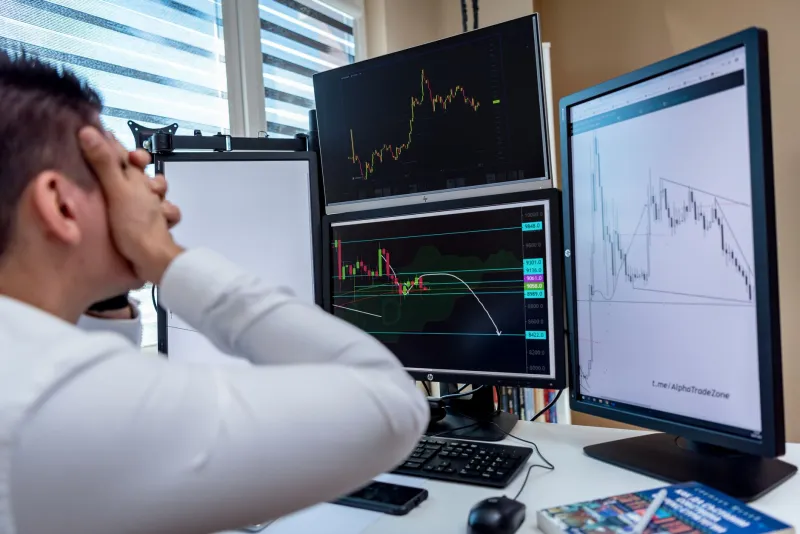
It usually starts with a price alert notification at a bad hour — late night, early morning, mid-work-day. The brain registers threat. Cortisol spikes. You open the app and the floor has dropped another 15%. You check Twitter. Someone with 40,000 followers is calling the whole sector dead. You go to Discord. Three people have already posted "NGMI" memes. Someone in the alpha channel says they're exiting their whole position.
At this point, your prefrontal cortex — the part of your brain responsible for long-term reasoning — is actively being suppressed by your stress response. You are not thinking clearly. You are running on the same neurological hardware that kept your ancestors alive on the savanna. That hardware has no framework for "illiquid JPEG with 6-month time horizon."
The intervention point is recognizing this state before you act. Some collectors literally write themselves a note and tape it somewhere visible: If I'm about to sell during a red day, I wait 48 hours. That's it. That's the whole system. The 48-hour rule kills most panic sells before they happen, because the emotional urgency almost always fades.
Diamond Hands Aren't Born, They're Engineered
There's a mythology in the NFT space that certain people are just built different — that diamond hands are a personality trait you either have or you don't. This is cope. Diamond hands are a system.
The collectors who consistently hold through volatility and come out ahead aren't emotionally invincible. They're structurally protected from their own worst impulses. They've pre-committed to decision rules. They've removed easy exit pathways during high-stress moments. They've surrounded themselves with long-term thinkers instead of panic merchants.
They've also, critically, done the work to understand what they actually own. When you deeply understand the cultural significance of Pepe as a meme asset — its longevity, its community depth, its organic global reach — a 40% floor drop reads differently than it does to someone who bought on hype alone. Conviction is a research output, not a personality trait.
The Exit You'll Actually Be Proud Of
None of this means hold forever no matter what. Knowing when to exit is a real skill. But exits based on changed fundamentals are completely different animals from exits based on fear, social pressure, or a bad night's sleep.
The collectors in the Pepe ecosystem who've built real wealth didn't get there by being lucky enough to never face a drawdown. They got there by having a clear enough framework to know the difference between a reason to sell and a feeling that tells them to sell.
Your future self — the one watching the floor pump after you didn't sell — will thank you for learning that difference now.
Stay froggy. Stay patient. Don't let a red candle turn you into a cautionary tale.